
Editorial
Why We Verify Every Price (and What We Found When We Did)
Stale listings, phantom discounts, and prices that differ by region: what live price verification catches, and why we link you out to the retailer.


Most product-recommendation sites have a quiet embarrassment at their core: the price you’re reading was true whenever the article was written, and the link you’re about to click leads wherever it happens to lead today. The review might be excellent. The commerce layer underneath it is often a fossil. Huntli’s founding design decision was to invert that priority: no product reaches your results until its listing has been checked against the retailer’s live page. We recently went through our verification logs to answer a fair question: what does that check actually catch? Here’s the audit, unflattering parts included.
What “verified” means here
When Huntli finds a product, it doesn’t stop at the search result. The pipeline visits the vendor’s page and confirms four things before a card ever renders: the current price, stock status, shipping to your region, and that the page sells the product we matched: not an accessory, a bundle, or a different variant wearing the same name. Then prices get cross-referenced across sources: a vendor sitting suspiciously far below consensus gets flagged, not crowned “cheapest.”
The scoreboard, from our own logs
Across the several thousand vendor pages our pipeline has verified and cached, about a quarter fail the check. Roughly a fifth of stock checks come back out of stock despite the listing claiming otherwise, and about one page in ten turns out to be the wrong product entirely. Several hundred more carried a price on the page that disagreed with the price in the feed that advertised them. That’s the hidden failure rate of raw shopping results: the reason this step exists.
Three catches from the logs
The accessory wearing the product’s name
Searching the Blueair Blue 3210 air purifier (a ~€200 device), the cheapest “matches” from five separate retailers were not the purifier at all. A major electronics chain’s page sold a replacement pre-filter; a large marketplace offered a fabric filter cover; another listed a generic replacement filter; a second-hand marketplace offered the wrong model. All five were caught by the identity check and rejected, with the reason logged verbatim: “is an accessory, not the air purifier itself.” A price sorter without verification would have crowned a €20 filter the “cheapest” purifier on the market.
The €11.99 flagship headphones
On a search for Sony’s flagship WH-1000XM6 (consensus around €330), one marketplace surfaced at €11.99. Real page, real number: it was a monthly rental fee scraped as a purchase price. The suspicious-price floor rejected it, as it did a €16.50 “Bose QuietComfort Ultra” and a €20.25 “Sennheiser Momentum 4.” This isn’t a rare edge case: that floor has fired over 1,800 times across nearly 1,400 distinct listings. Too-good-to-be-true is a high-volume category.
The discount you can’t take at face value
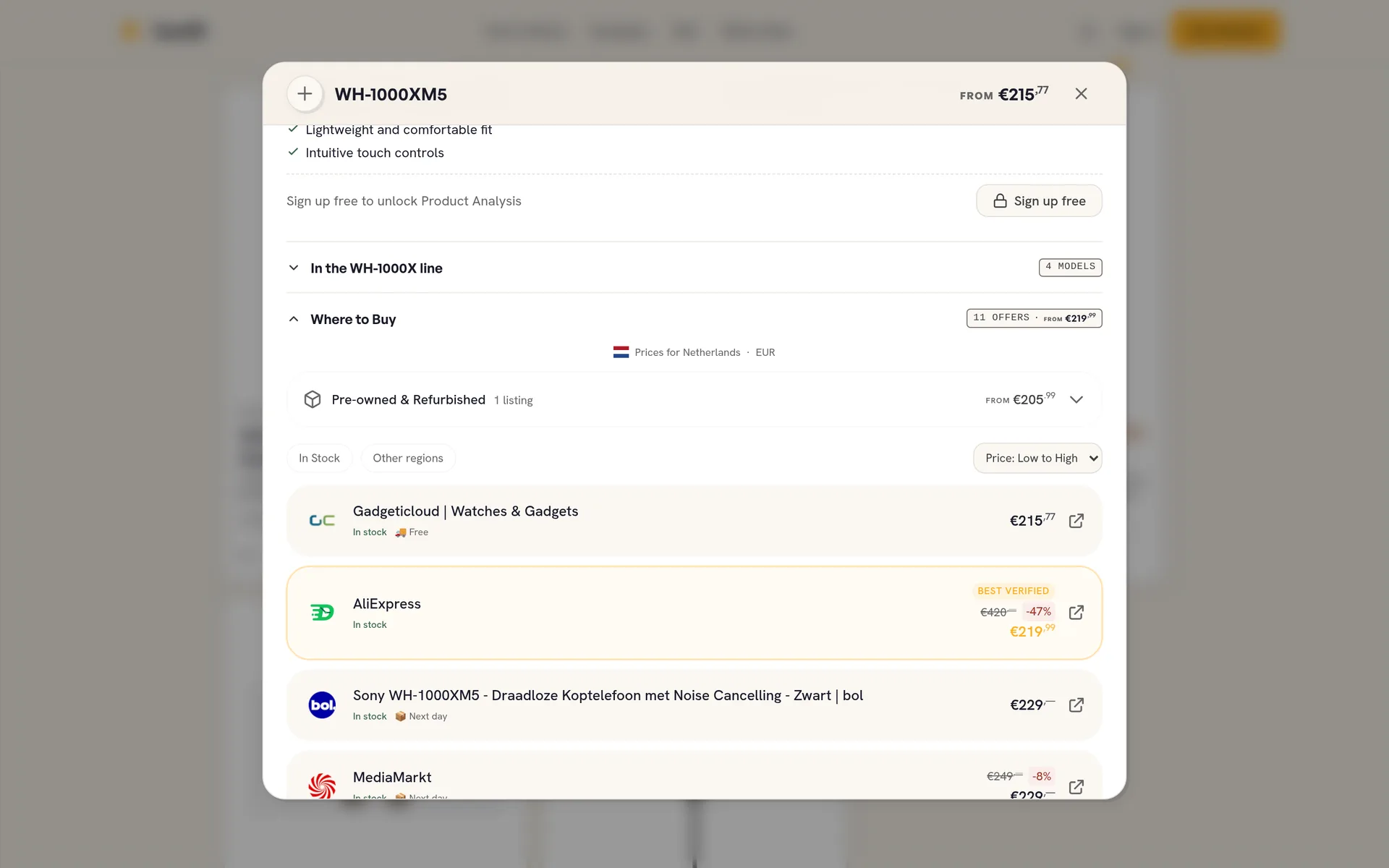
In our skincare showcase, one import reseller lists The Ordinary’s Vitamin C suspension at €27.89, “was €69.28” — beside sellers clustered around €10, apparently a sevenfold markup on a €9 serum. It isn’t: the listing title reveals a multi-bottle set, so both of its numbers price several bottles against everyone else’s one. Sizes, bundles, and multipacks all publish “a price,” and a discount banner never tells you what the price is for — what verification caught here wasn’t a scam, it was an incomparable column. The genuinely fictional anchor exists too, and it looks like this:
Border pricing
The same product routinely carries different prices across the 16 regions Huntli covers: currency, VAT, import routes, and plain market-by-market strategy all contribute, and import resellers love to bridge the gap at a markup. Verifying per region, in local currency, means you see your market’s truth instead of a converted approximation, and an “imported” price stops masquerading as a deal.
Why we link out instead of locking you in
Every result on Huntli ends at the retailer’s own product page: you buy from the store, at the store’s price, with the store’s buyer protections. Some of those links may earn us a commission at no extra cost to you; that’s how a free product pays its bills. The useful side effect is alignment: a service that benefits only when your purchase works out has every reason to send you somewhere real, in stock, and correctly priced.
The test any comparison site should survive
Including this one — don’t take “verified” on faith. The test is one click: the price on the retailer’s page should be the price you were shown, the item should be in stock, and the product should be the product. A comparison site that survives that click every time is doing the work; one that doesn’t is decoration around an affiliate link. We built Huntli to survive it. Run a search and click.