
How Huntli Scores Products: Value, Specs, and What Owners Actually Say
The machinery behind the number: three transparent dimensions, what deliberately is not in the score, how personas move the weights — and when to overrule it.

Every comparison site hands you a number. Almost none of them tell you where it came from — which is convenient, because a score you can’t interrogate is a score you can’t argue with. We think the number is only useful if you can see the machinery, so this piece opens ours up: what goes into a Huntli score, what deliberately doesn’t, and when you should overrule it.
Five things, fixed per category
Every product category on Huntli has a rubric: the five things a reviewer of that category would actually judge. Espresso machines are scored on extraction, milk texturing, build, workflow and footprint; headphones on sound, noise cancelling, comfort, battery and call quality; a graphics card on something else entirely. The rubric is written once per category and then frozen, so two products in the same category are always judged on the same five things — and so are the same product on Tuesday and the same product next month.
Each dimension comes with anchors: a description of what a 90, a 70 and a 50 look like at that price, naming real products that sit there. The scoring model reads the anchors, not the room. A product that matches the 90 anchor is a 90 whatever else is on the table; one that is merely fine at its price is a 60-something, not an 85. Reserving the top band for products that lead their price class is the whole point — a scale where everything competent lands in the eighties tells you nothing.
A dimension with no evidence in the data is marked not assessed and left out of the score. A missing warranty field is not a bad warranty. Scoring absence as a defect was the single biggest source of unfair numbers, so the rule is absolute.
One score per product, read everywhere
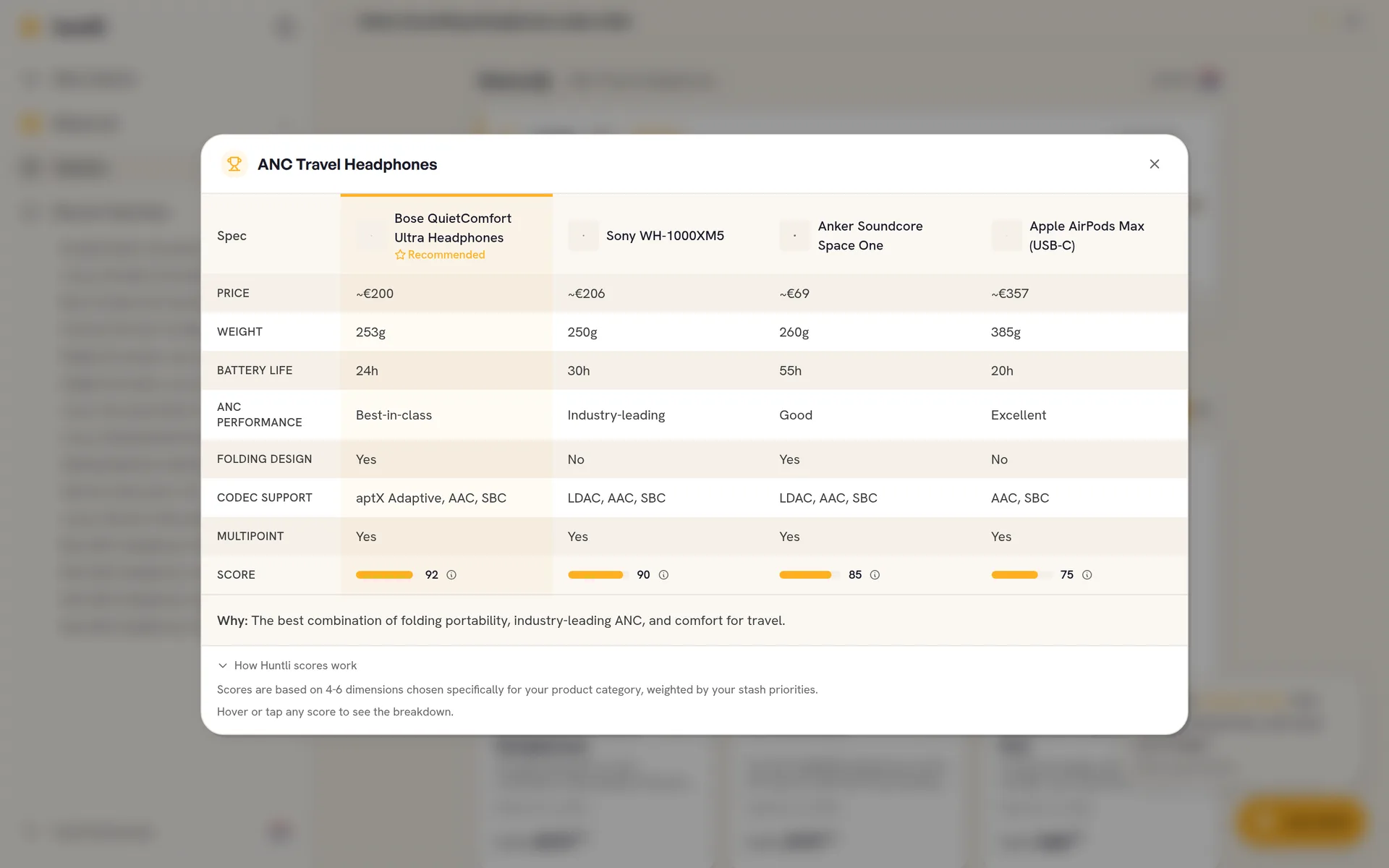
A product is scored once, on its own, against its category’s rubric — never in a batch with whatever else happened to be in your Stash. That matters more than it sounds: scored beside stronger products, the same item used to drift down a few points; beside weaker ones, up. Now the comparison table, the head-to-head verdict and the deep product analysis all read the same scorecard rather than each producing their own opinion. When the analysis runs, it scores the same five dimensions in more depth, with the evidence written out per dimension, and its verdict replaces the quicker one.
Your priorities move the number — visibly
The rubric’s five dimensions have default weights, and that weighting produces the product’s base score. Your Shopping Persona and the priorities you set on a Stash re-weight the dimensions that match them: tell Huntli the machine has to fit a small kitchen and footprint counts for more. The number you see is the adjusted one, and beside it sits the adjustment itself — +4 for your priorities, or −3, naming the dimensions that moved it. The score isn’t pretending there’s one objective ranking; it’s showing you the objective part and the part that is yours, separately.
What deliberately isn’t in the score
Affiliate relationships. Like everywhere on Huntli, some outbound retailer links in our comparisons may earn us a commission at no extra cost to you. The scoring pipeline has no visibility into which links those are: every product runs through the same code path, and rankings never depend on how, or whether, a purchase supports Huntli. The disclosure at the bottom of this page describes that architecture, not just a policy. Brand reputation gets no standalone bonus either; it has to earn its way in through the five dimensions. And owner ratings are context for the model, not a dimension — a thousand five-star reviews are not evidence that a product leads its price class.
When to overrule the number
A score compresses; compression loses things. It doesn’t know your head shape, your existing ecosystem, or that you find a product ugly: legitimate reasons to buy the 72 over the 81. Two rules of thumb: treat gaps of a few points as a tie broken by your own taste, and treat a big gap on the dimension you care about as the signal that matters — that is exactly what the breakdown is for. The score’s job is to shrink thirty tabs to three candidates and show its work. The last call was always yours.
Keep reading
Researching a purchase of your own?
Describe what you need in plain language — Huntli finds real products, verifies prices across retailers, and scores them honestly. Free to use.
Some retailer links on Huntli may earn us a commission at no extra cost to you. Commissions never influence scores or rankings. How we make money